The Garden Vita Sackville-West Built in a Ruin
November 2, 2026
When Vita Sackville-West and Harold Nicolson bought Sissinghurst in the early months of 1930, the famous garden did not exist. The National Trust's history of the place is blunt about the condition. Farm workers lived in the buildings. None of the rooms were fit to live in. The ground that is now a sequence of garden rooms was growing vegetables for those workers, and it was also growing rubbish: sardine tins, cabbage stalks, rusty bedsteads. Around it, a working farm grew cereals, fruit, and hops. Vita did not mind the mess. She minded the walls. Walls and space, she thought, were enough, because they let her plant the roses and honeysuckle, the figs and vines, in the abundance she had been writing about and had not had room to grow.
The site was already old. A medieval manor had stood inside a moat. Under Elizabeth the Baker family replaced it with a large house, then lost their money in the Civil War. By the time the Nicolsons arrived, enough of the house had been demolished that what remained was a fragment: the entrance range, the priest's house, and the four-story brick tower where Vita would keep a study and write. The National Trust Collections note calls that tower the distinctive piece. The garden is what they made in the gaps.
They did not do the same job. The Trust's account of the planting, and the heritage record of the garden, divide the work cleanly. Harold wanted straight lines, a classical frame, what he called a succession of intimacies, rooms linked by views. Vita wanted the soil hidden. She gardened, the Trust says, as a gifted amateur, without a hunger for perfection, and she wanted beds bursting. The rose garden went into a former kitchen garden and was filled with the old roses she actually liked. The yew walk was planted in 1932. Four Irish yews went in that year at the midpoint of the path from the gatehouse to the tower. A purple border was built against the north wall in 1935. The lion pond, made in 1930, was drained in 1939 and became a small sunken garden for plants that like moisture. The nuttery was already there, planted about 1900. They inherited some structure and argued the rest into being.
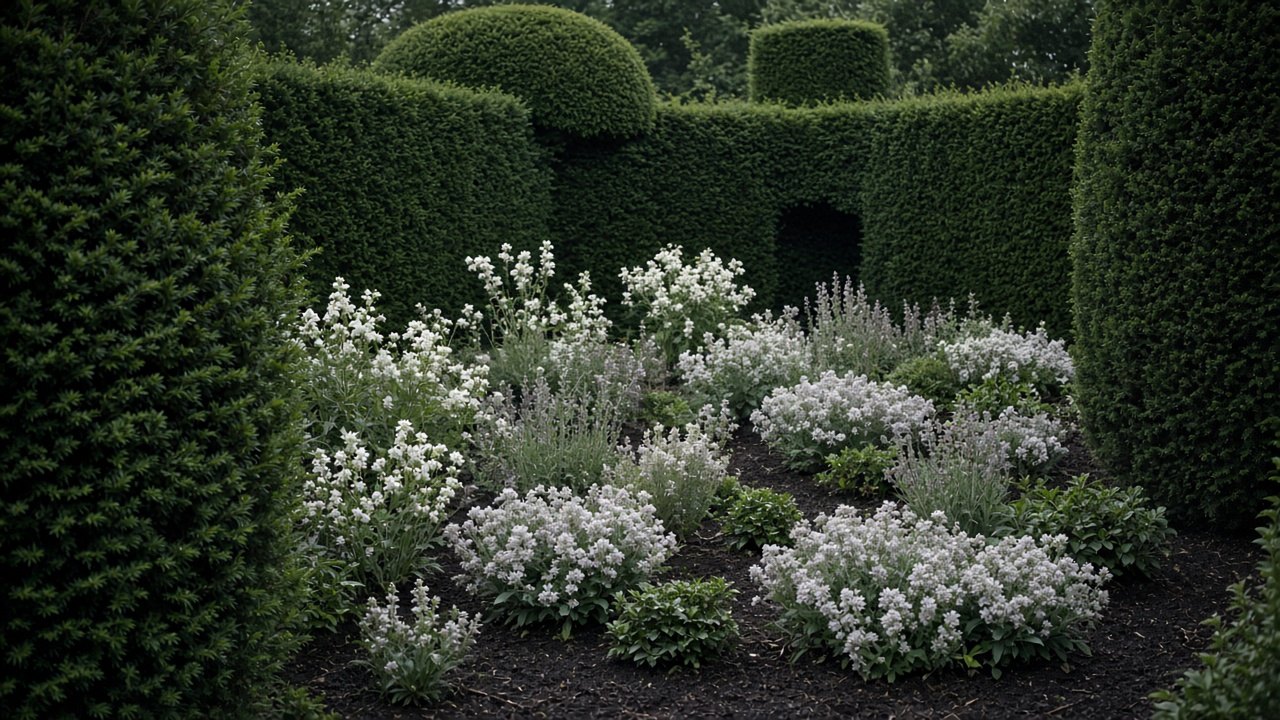
The garden opened to the public in the late 1930s. Admission was one shilling. Vita called the visitors shillingses. They dropped the coin in an old tobacco tin on a table under the entrance arch. That detail, from the Trust, is the opposite of a private poem. A garden this photographed began as a place that charged a small fee and trusted people to pay it into a tin. The White Garden, the one most visitors come to see, is not the 1930s rose garden. The heritage record says Vita and Harold laid it out after the war, in place of a more conventional rose garden: a cross of paths, low box, plants chosen because they read as gray or white, a vine-covered loggia where the couple ate outside. The iron rose arbor at the center was designed by their son Nigel in 1970, after Vita's death. The picture in a postcard is a collaboration across three decades and at least three people, plus the head gardeners who kept it. Pamela Schwerdt and Sibylle Kreutzberger held that job together from 1959 to 1991.
The Trust is also clear that Sissinghurst is not an accident of soil. It is a design argument you can walk. Harold's rooms make the views. Vita's planting makes the rooms feel occupied rather than drawn. The heritage record puts the whole at about six acres, inside what is left of the Tudor walls and two arms of a twelfth-century moat. An orchard of apples that predate the Nicolsons sits inside the moat. A statue of Dionysus and a gazebo of 1969 close the long view. None of this is a cottage border that happened. It is a small estate, bought cheap because it was a wreck, arranged by a diplomat who thought in axes and a novelist who thought in flowers.
The useful part, for a gardener who will never own a tower, is the division of labor and the order of operations. They cleared rubbish before they planted roses. They accepted a vegetable ground and a nuttery instead of scraping the site to bare fashion. They charged admission early, which meant the garden had to be legible to strangers, not only to its makers. And they kept changing it. The white garden is a revision. The drained pond is a revision. A garden that looks inevitable in July was, in 1930, a pile of tins and a set of walls. Vita saw the walls. Harold drew the paths. The flowers are the part that still has to be done again every year, which is the part a garden never finishes.
The Trust's account is also a warning against treating the postcard as the whole design. The rose garden in the old kitchen ground, the yew walk of 1932, the purple border of 1935, and the White Garden after the war are different decades answering different problems. Vita wanted profusion. Harold wanted rooms you discover rather than a single view you consume. The head gardeners who stayed, Pamela Schwerdt and Sibylle Kreutzberger from 1959 to 1991, are the reason a visitor in a later summer still meets that argument in living plants rather than in a plan chest. A famous garden is a staff. Sissinghurst's fame is often told as a marriage of two tastes. The heritage record makes room for the people who pruned the yews and replanted the white bed when the taste had to be done again in soil, not in prose. If you copy anything, copy the sequence: clear the ground, accept what is already growing, charge yourself with a path a stranger could follow, and expect to revise the planting after the first idea has had a decade to show its faults.
Sources
- https://www.nationaltrust.org.uk/visit/kent/sissinghurst-castle-garden/the-history-of-sissinghurst-castle-garden
- https://www.nationaltrustcollections.org.uk/place/sissinghurst-castle-garden
- https://heritagerecords.nationaltrust.org.uk/HBSMR/MonRecord.aspx?uid=MNA128195
- https://www.nationaltrust.org.uk/visit/kent/sissinghurst-castle-garden
- https://www.nationaltrust.org.uk/visit/kent/sissinghurst-castle-garden/the-garden-at-sissinghurst-castle-garden